Pleiades (M45): 2012 to 2026
The Seven Sisters twice, fourteen years apart: from 29 minutes with a DSLR at Lake San Antonio to the 10-inch Newtonian and a cooled monochrome camera.

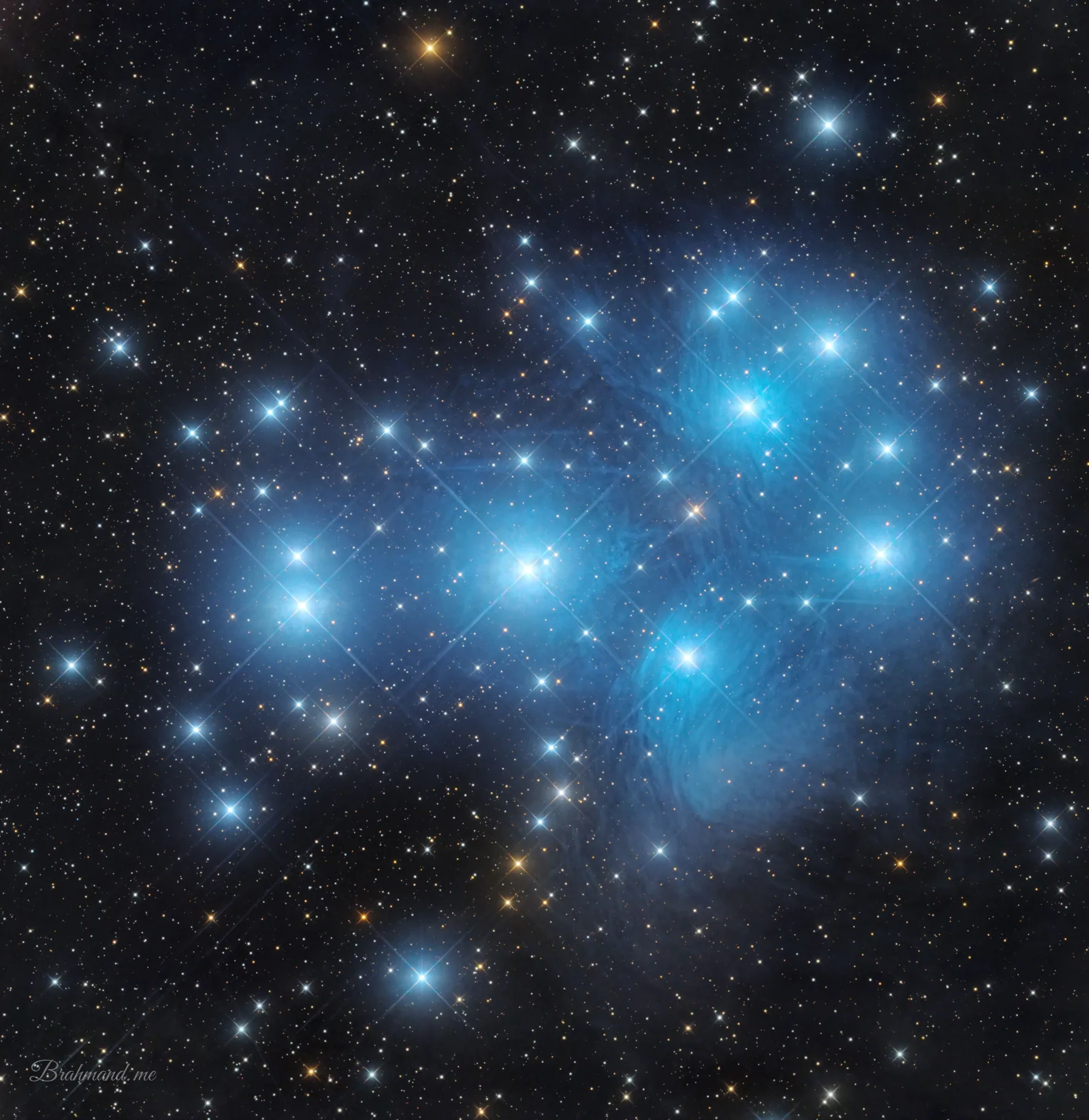
2012: Lake San Antonio
The first Pleiades came from Lake San Antonio, a fairly dark site: a composite of about 29 minutes with the Astro-Tech AT111 on the Atlas EQ-G and a Canon 60D, guided with an Orion Starshoot autoguider. Even then the blue reflection nebulosity around the bright stars showed, something small telescopes rarely reveal to the eye.
2026: the 10-inch Newtonian
The 2026 image used the AGO 10″ f/3.8 imaging Newtonian on the Paramount MyT with a cooled monochrome ZWO ASI6200.
What changed
- Aperture and speed: the fast 10-inch Newtonian gathers several times more light per minute than the 111 mm refractor.
- The dust: the faint, streaky reflection nebulosity between and around the stars, barely hinted at in 2012, is now the subject.
- Star colour and size: a monochrome camera with separate colour filters keeps the bright stars tighter and their blue colour cleaner.

