Andromeda Galaxy (M31): 2011 to 2024
From a few unguided DSLR frames at a 2011 star party to more than twenty hours of mono and hydrogen-alpha data: thirteen years on our nearest large galactic neighbour.

2011: the first attempt
Our first Andromeda was taken at the Santa Margarita star party on July 27, 2011, with the Astro-Tech AT111 refractor on the Atlas EQ-G and an unmodified Canon 60D. The subs were unguided, so each exposure had to stay short, and a colour DSLR records only part of the light that reaches it.
2024: twenty hours later
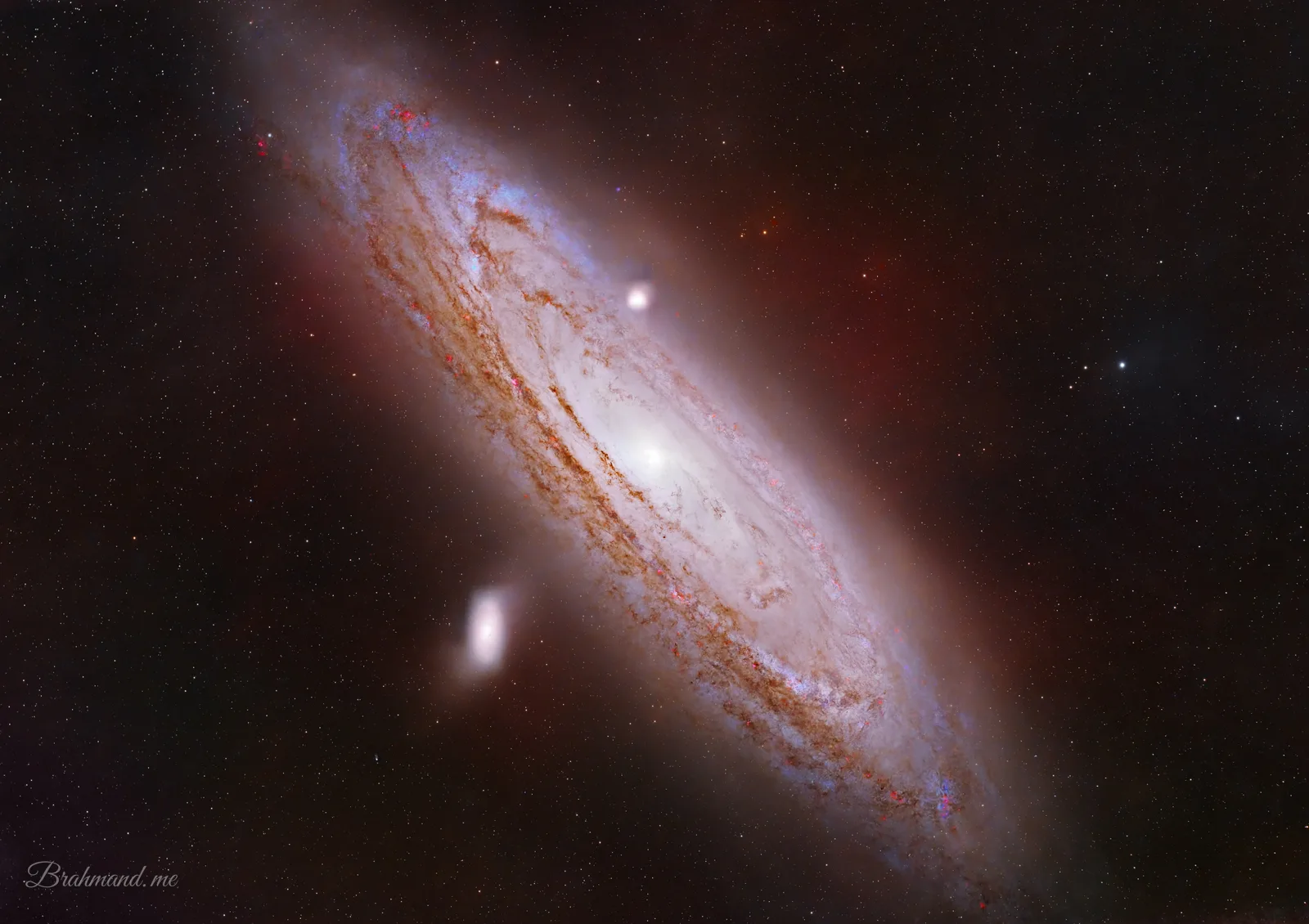
The 2024 image was made with a Takahashi FSQ-106 on a ZWO AM5 and a cooled monochrome ZWO ASI6200, from a Bortle 4–5 site near Mariposa, with the hydrogen-alpha collected from home. In total there are more than 20 hours of data.
What changed
- Camera: an uncooled colour DSLR became a cooled monochrome sensor, so every pixel records every filter and the noise is far lower.
- Hydrogen-alpha: the narrowband data brings out the red star-forming regions strung along the spiral arms, invisible in the 2011 frame.
- Integration: minutes became more than twenty hours, which is what reveals the faint outer halo and the dust lanes.
- Field: the FSQ-106’s flat, wide field holds the whole galaxy with M32 and M110 sharp to the corners.

